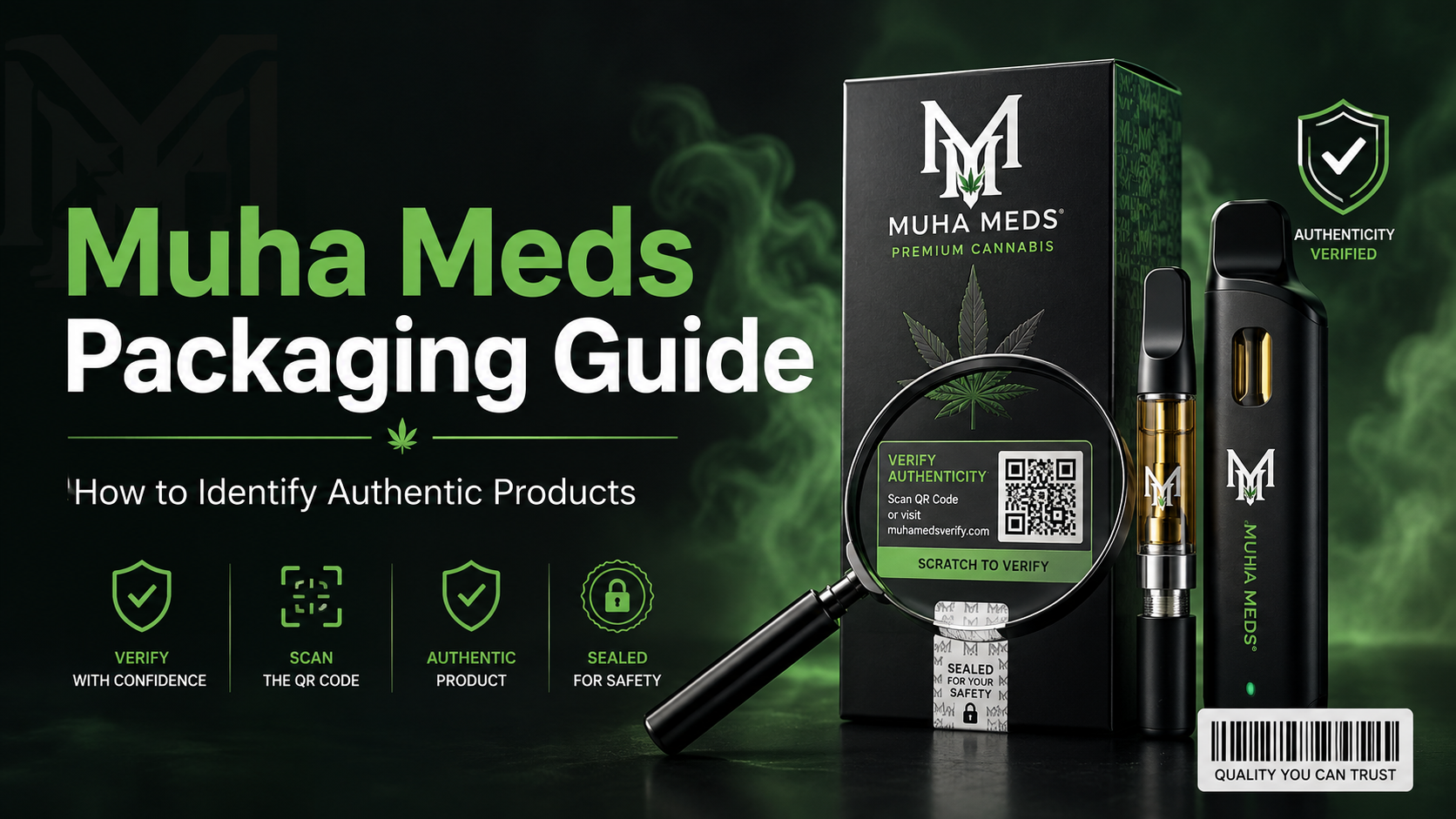
Muha Meds Packaging Guide: How to Identify Authentic Products.
Read our Muha Meds Packaging Guide to learn about QR codes, verification features, packaging details, authentication methods, and how to identify suspicious products.
Muha Meds has become a recognizable name in the cannabis market, making product packaging and authentication increasingly important for consumers. As popular brands become more widely recognized, packaging may be copied, altered, or imitated by unauthorized sellers. Understanding what to look for can therefore help consumers make more informed decisions.
This Muha Meds Packaging Guide explains the key elements commonly associated with Muha Meds packaging, how the brand’s current verification system works, what information consumers should check, and why packaging appearance alone should never be considered complete proof of authenticity.
Whether you are researching Muha Meds cartridges, all-in-one devices, flower, concentrates, or other products, knowing how to examine the package is an important first step.
Why Muha Meds Packaging Matters
Packaging serves several purposes beyond making a product visually appealing.
For regulated cannabis products, packaging can communicate important information about the product, including its identity, variety, manufacturer information, batch details, warnings, testing information, and authentication method where applicable.
Packaging is also one of the first things counterfeiters attempt to imitate.
A package that looks convincing in photographs does not automatically mean the product inside is authentic. High-quality printing and packaging materials have become widely accessible, which means consumers should rely on official verification methods whenever they are available.
That is particularly important with a recognizable brand such as Muha Meds.
What Does Authentic Muha Meds Packaging Look Like?
There is no single package design that applies permanently to every Muha Meds product.
Packaging can differ according to:
- Product category
- Product generation
- Strain or flavor
- Device type
- Package size
- Market
- Regulatory requirements
- Packaging redesigns
For this reason, consumers should avoid relying on a single photograph found online as their only authentication method.
Instead, examine several features together and then use the official Muha Meds verification system.
1. Check the Muha Meds Branding
Start by examining the overall branding.
Look closely at elements such as the:
- Muha Meds name
- Logo
- Typography
- Product name
- Strain or flavor name
- Printed graphics
- Package layout
Professional packaging should generally have clean printing and consistent branding.
Be cautious when you notice obvious problems such as misspelled words, poorly aligned text, unusually blurry graphics, distorted logos, inconsistent fonts, or labels that appear to have been placed over unrelated packaging.
However, appearance alone cannot authenticate a product. Counterfeit packaging can sometimes closely resemble genuine packaging.
2. Look for Product Identification Information
The package should clearly identify what the product is.
Depending on the product and applicable market requirements, this may include information such as the product category, strain or flavor, quantity, cannabinoid information, batch information, warnings, or other labeling.
Read these details carefully.
Information on different parts of the package should make sense together. For example, the product name printed on the front should correspond with identifying information elsewhere on the packaging.
Large inconsistencies deserve additional investigation.
3. Find the Muha Meds Verification Feature
Verification is one of the most important parts of this Muha Meds Packaging Guide.
Muha Meds currently describes two authentication methods, depending on the generation of the product.
Second-Generation Muha Meds Products
According to the official Muha Meds verification page, second-generation products use a scratch-off verification code.
Consumers can reveal the code and submit it through the appropriate official verification system to check authenticity.
Third-Generation Muha Meds Products
The newer third-generation system uses the Muha Members app.
The official Muha Meds website instructs consumers with these newer products to use the app to scan their product for authentication.
Because Muha Meds has changed its verification technology over time, seeing a different authentication format does not necessarily indicate that a package is counterfeit. The important question is whether the verification method corresponds with an official system supported by Muha Meds.
4. Check the QR Code Carefully
QR codes are common on modern product packaging, but simply having a QR code does not prove authenticity.
Counterfeiters can print QR codes too.
When examining a Muha Meds QR code:
- Locate the verification information on the package.
- Follow the instructions associated with that particular product generation.
- Make sure you are using an official Muha Meds verification method.
- Complete the verification rather than assuming the presence of a QR code is sufficient.
- Be cautious if a code redirects somewhere unexpected or cannot be authenticated through the appropriate official system.
A QR code should be treated as a pathway to verification—not as verification by itself.
5. Understand Scratch-Off Verification Codes
Some Muha Meds packaging uses a concealed verification code.
The purpose of the scratch-off section is to provide a product-specific credential that the consumer can reveal and verify.
When examining this type of package, look for evidence that the verification area has already been disturbed.
If a supposedly new product arrives with its authentication area already scratched, damaged, removed, or obviously altered, further verification is advisable before relying on the product.
Follow the instructions on the official Muha Meds verification platform rather than using unofficial verification websites.
6. Use the Muha Members App for Newer Products
Muha Meds has introduced the Muha Members app as part of its newer authentication system.
According to the brand’s official website, the app supports product scanning and verification. Muha Meds currently directs consumers with third-generation products toward app-based authentication.
This is important because older online guides may describe only scratch-off labels and QR codes.
Packaging evolves.
If you are researching a newly released product, prioritize current information from the brand’s official verification resources rather than assuming that older packaging instructions still apply.
7. Examine Printing Quality
Printing quality can provide useful clues, although it should never be your only test.
Look for:
- Sharp text
- Properly aligned graphics
- Consistent spacing
- Clear product names
- Clean barcodes or QR codes
- Consistent typography
- Correct spelling
Extremely blurry printing, obvious spelling errors, crooked labels, or graphics that appear stretched or pixelated may justify additional scrutiny.
Remember, however, that professional-looking packaging can also be copied.
Always combine visual inspection with digital authentication.
8. Check Whether the Packaging Appears Tampered With
Inspect the package before opening it.
Signs that deserve attention can include:
- Broken seals
- Torn packaging
- Labels placed over other labels
- Previously opened boxes
- Damaged authentication stickers
- Removed scratch-off areas
- Packaging that appears to have been resealed
Tampering does not automatically prove counterfeiting because packaging may occasionally be damaged during handling or transportation.
Still, a visibly altered package should not simply be ignored.
9. Compare the Product With Current Official Information
Muha Meds packaging changes over time.
That makes outdated photographs one of the biggest sources of confusion surrounding authenticity.
A package might look different from an image posted several years ago because the brand has redesigned its packaging, changed hardware, introduced a new generation, or updated its verification system.
Instead of searching only for:
“Does my Muha Meds look real?”
A better approach is:
“Does this particular product correspond with current official Muha Meds product and verification information?”
This provides a much stronger basis for evaluating authenticity.
Real vs Fake Muha Meds Packaging: Warning Signs
No single visual characteristic definitively proves that a package is counterfeit.
However, several warning signs appearing together should encourage additional caution.
Potential red flags include:
- Verification that does not work through the appropriate official system
- Missing authentication information where expected
- Misspelled branding
- Poor print quality
- Incorrect or inconsistent product names
- Damaged verification labels
- Packages that appear resealed
- QR codes leading to suspicious destinations
- Conflicting information across different parts of the package
The most important warning sign is a failure to authenticate a product that is supposed to support official verification.
Can Fake Muha Meds Packaging Have a QR Code?
Yes.
The presence of a QR code alone should never be considered proof that a cannabis product is authentic.
A printed QR code can potentially be copied.
What matters is what happens when the authentication process is completed.
Consumers should follow the verification process appropriate to their product generation and use official Muha Meds resources rather than trusting the visual presence of a QR symbol.
Can Fake Packaging Look Exactly Like Real Packaging?
Counterfeit packaging can sometimes be highly convincing.
That is why visual comparisons have limitations.
A consumer may compare two boxes and find nearly identical:
- Colors
- Fonts
- Logos
- Artwork
- Product names
- QR-code placement
Yet one package may still be unauthorized.
Authentication technology, purchasing source, product traceability, and applicable regulated-market labeling can therefore provide more meaningful information than appearance alone.
Does Muha Meds Packaging Change?
Yes.
Consumers should expect packaging and verification systems to evolve.
Muha Meds’ current official verification information itself demonstrates this transition: second-generation products use scratch-off verification codes, while newer third-generation products are authenticated through the Muha Members app.
Therefore, an older Muha Meds Packaging Guide may not accurately represent every product currently circulating.
Always check current official information when verifying a recently produced package.
Muha Meds Packaging Verification Checklist
Before relying on a product’s packaging, review this checklist:
Branding:
Does the logo, product name, typography, and overall presentation appear consistent and professionally printed?
Product information:
Does the package clearly identify the product, and is the information internally consistent?
Verification:
Does the product contain the authentication method appropriate for its generation?
QR or authentication code:
Does the verification process successfully work through the appropriate official Muha Meds system?
Package condition:
Does the packaging appear unopened and untampered with?
Current design:
Are you comparing the package with current information rather than photographs from several years ago?
If something does not add up, investigate further rather than relying on the appearance of the box.
Frequently Asked Questions About Muha Meds Packaging
How do I verify Muha Meds packaging?
The process depends on the product generation. Muha Meds currently states that second-generation products use scratch-off verification codes, while newer third-generation products can be authenticated using the Muha Members app.
Where is the Muha Meds verification code?
For products using the scratch-off system, locate the verification feature on the packaging and follow the instructions associated with the official Muha Meds verification portal.
Packaging placement may vary, so follow the instructions printed on your particular product.
Does every Muha Meds product use the same packaging?
No. Packaging varies between product lines, strains, flavors, generations, and markets. Packaging can also be redesigned over time.
Does a Muha Meds QR code mean the product is real?
Not automatically.
The QR code should lead into the appropriate authentication process. A printed QR code by itself is not sufficient evidence of authenticity.
Why does my Muha Meds package look different from pictures online?
You may be comparing different product generations, product categories, markets, or packaging versions. Muha Meds has changed its authentication system over time, so older images are not always useful when evaluating newer products.
What should I do if my Muha Meds verification fails?
Double-check that you are using the correct verification method for the product generation and that you are accessing an official Muha Meds resource. If verification still fails, avoid making authenticity assumptions based solely on the appearance of the packaging.
Final Thoughts
Understanding packaging is an important part of researching cannabis product authenticity, but appearance should never be the only factor considered.
The strongest approach combines careful inspection of the Muha Meds packaging with the brand’s current authentication system.
Check the branding, product information, packaging condition, verification feature, and QR or scratch-off system carefully. Most importantly, complete the official verification process whenever the product provides one.
Muha Meds currently supports different verification methods depending on product generation, including scratch-off authentication for second-generation products and app-based scanning for newer third-generation products.
As packaging continues to evolve, consumers should rely on current official information instead of outdated photographs or appearance alone.
A professional-looking box can be copied.
Successful authentication through the appropriate official verification system provides much stronger evidence than packaging appearance by itself.